Why Document Generation Should Take 5 Minutes, Not 2-3 Weeks
How Setup Became the Product
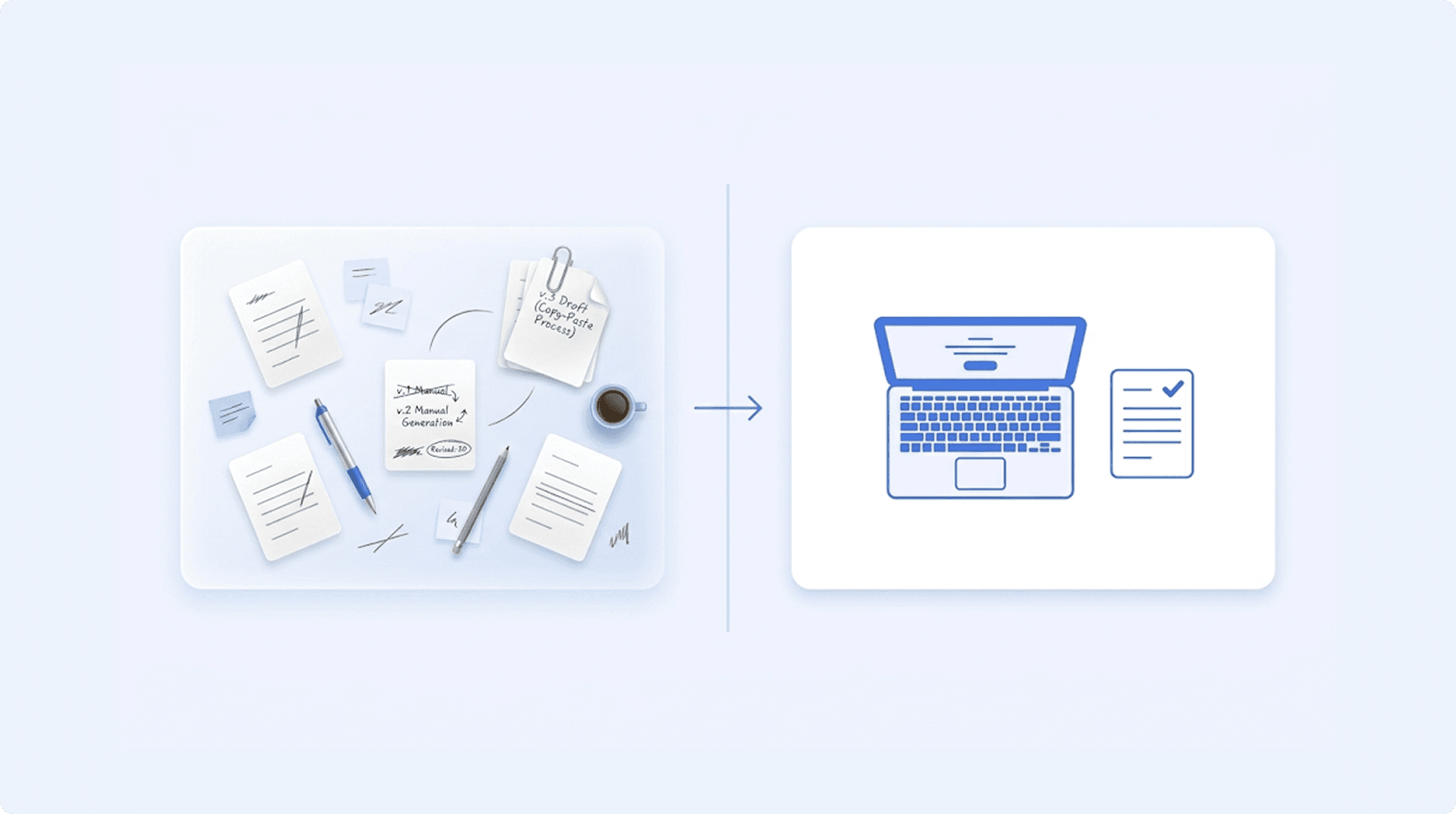
You buy software to save time. So the first thing it does is take 2-3 weeks of your time to deploy.
This isn't a joke. It's the standard enterprise software experience. You buy a tool to make your team faster.
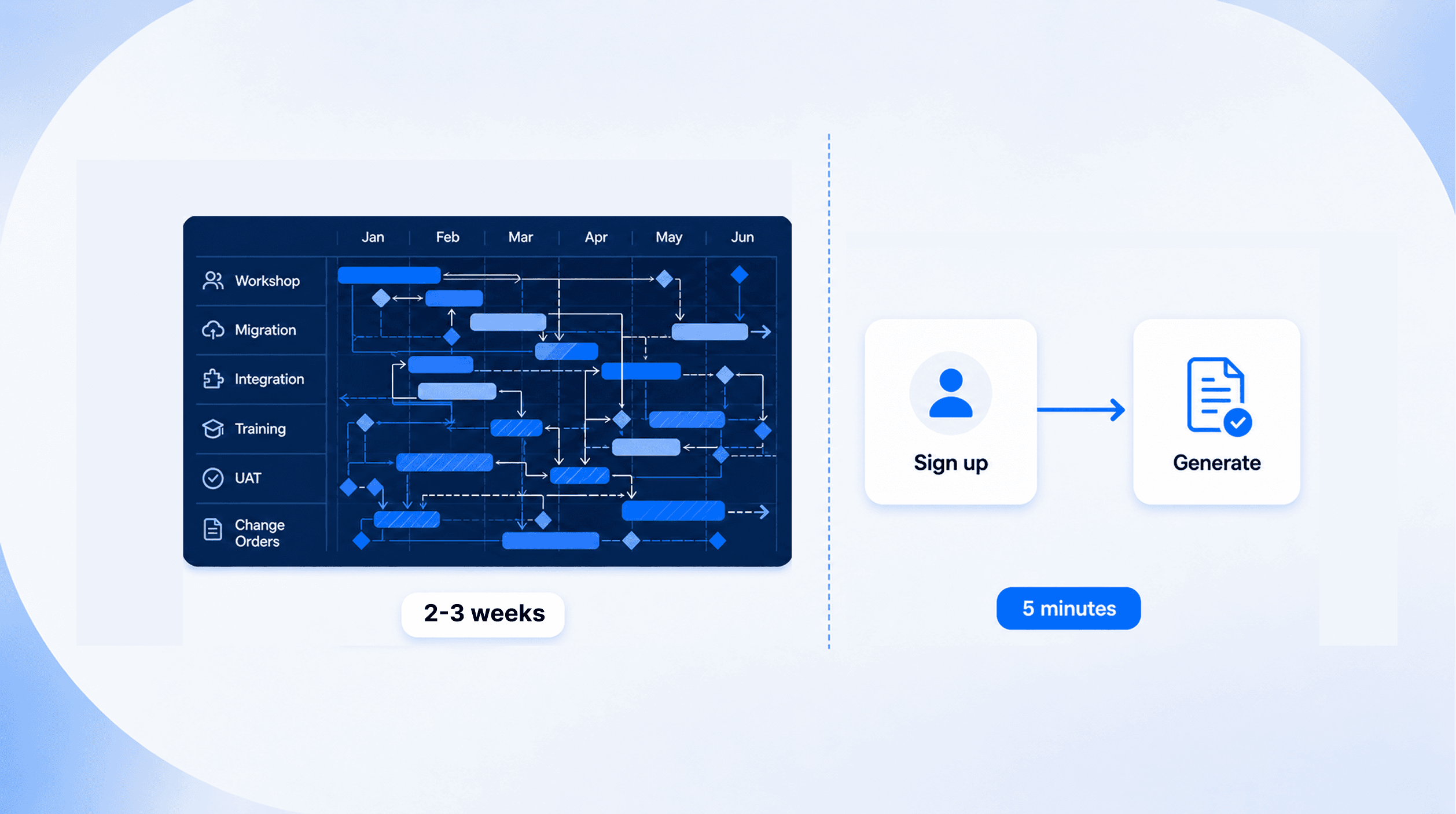
Before it can make your team faster, you spend 2-3 weeks in workshops, training sessions, template migrations, integration projects, and acceptance testing.
By the time the tool is live, the requirements have changed, the original team has rotated, and the templates the consultant migrated for you are already out of date.
We've all lived through some version of this. We've mostly stopped questioning whether it has to be this way.
It doesn't.
For most software categories, modern SaaS has already solved the setup problem. Nobody takes more than a few minutes to deploy Slack. Nobody takes more than a few minutes to deploy Notion, or Linear, or Figma. You sign up, you invite your team, you start using them. That model never reached enterprise document generation. It should have.
This post is about why fast setup is a technical decision, not a marketing line. What it actually requires under the hood. What it asks you to trade away. And why, for most document generation work, it's the only sensible choice.
What "2-3 Weeks" Actually Contains
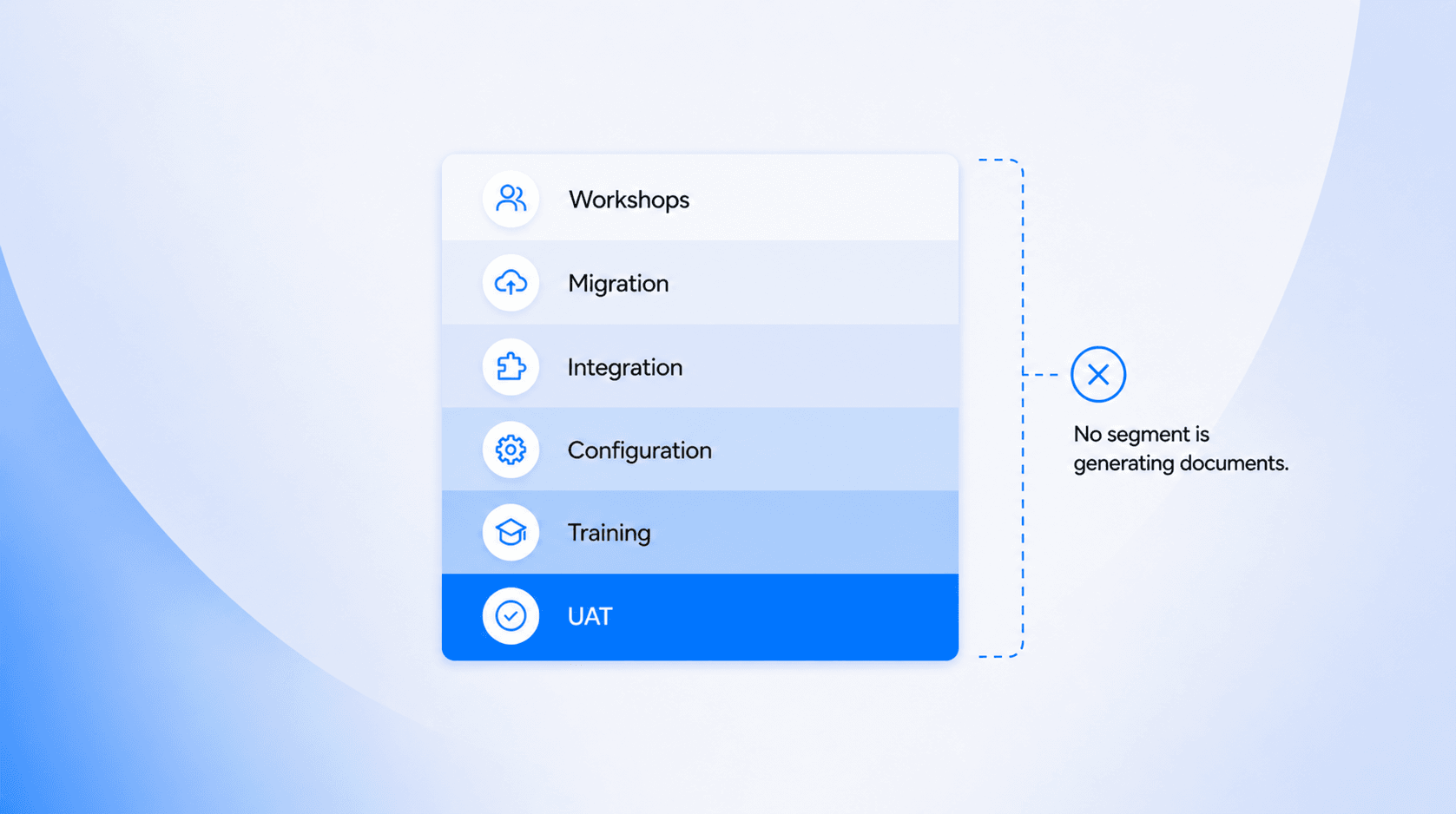
A typical enterprise rollout breaks down roughly like this:
I. Requirements workshops: weeks of meetings to map out which templates exist, who owns them, how they're structured today, and what the new tool needs to support
II. Template migration: porting existing Word templates into the tool's proprietary template format, often by a third-party consultant
III. Integration: connecting the tool to Salesforce objects, your HRIS, or whatever data lives elsewhere in the business
IV. Configuration: setting up users, permissions, approval flows, naming conventions, retention policies
V. Training: programmes for the admin team, the template authors, and the end user
VI. UAT: weeks of "user acceptance testing" before anyone is allowed to use the tool in production
None of that is product value. All of it is overhead. It's fine if the value the tool delivers downstream is large enough to justify that upfront cost. For complex CLM, CPQ, or revenue platforms, sometimes it is. For teams that just need to generate documents, it almost never is.
What "5 Minutes" Actually Looks Like
Setup that takes five minutes isn't magic. It's the absence of the artificial complexity above.
Here's what a five-minute setup for document generation actually looks like in practice:
1. Minute one: Sign up at the vendor's website. Confirm your email.
2. Minute two: Log in. Land on a working dashboard.
3. Minute three: Upload a Word document as your template. The tool detects the placeholders automatically.
4. Minute four: Map the placeholders to your data source: a spreadsheet, a Salesforce object, a simple web form, a direct API call.
No consultant. No configuration phase. No training programme. No UAT. The product works the moment you log in, because it was designed to work the moment you log in.
The first document you generate is a real document, not a sandbox demo. By the time someone in a Conga deployment is finishing the requirements workshop, you've already issued a quarter's worth of contracts.
The Compounding Cost of Slow Setup
Slow setup isn't a one-time cost. It compounds, quietly, for as long as the tool is in your business.
Every template change becomes a project. When the original setup required a consultant, the next change usually does too. Templates that should be edited in minutes get queued behind admin tickets that take weeks.
Every new team member is a re-onboarding. Tools that needed extensive training to set up need extensive training to use. Hire a new HR specialist? Three days of tool training before they can issue an offer letter.
Every new use case is a new project. The first set of templates took 2-3 weeks. Adding a second set for a new department takes another week or two. Each expansion is its own mini-implementation.
Every integration change cascades. When upstream systems update (your HRIS gets a new field, your Salesforce objects get reorganised), the document tool's integration breaks. Fixing it is another consultant engagement.
A tool that took five minutes to set up takes five minutes to update. A tool that took 2-3 weeks keeps charging you in weeks for the rest of its life inside your business.
When Five-Minute Setup Matters Most
• Early-stage teams that can't carry a 2-3 week implementation project alongside the rest of their work
• Fast-moving teams whose templates change often: legal teams updating clauses, HR teams hiring across new jurisdictions, ops teams onboarding clients with custom paperwork
• Teams without dedicated admins who can't afford to staff or contract a person whose entire job is keeping a document tool running
• Organisations new to a market (like the GCC) where the templates themselves are still evolving, and locking into a 2-3 week implementation freezes a moving target
If your situation matches one of those, slow setup isn't a feature you've outgrown. It's a tax you don't need to pay.
A Practical Test
The next time you're evaluating a document generation tool, ask the vendor these five questions:
1. How long until I can generate my first real document? If the answer is measured in weeks, the tool isn't designed for users. It's designed for consultants.
2. Do I need a dedicated admin to operate this? If yes, you're committing to a permanent staffing decision, not just buying a tool.
3. Can the team that owns the document edit the template directly? If template changes route through an admin or consultant, every change is a project.
4. What happens when our template needs to change? If the answer involves tickets and timelines, the tool isn't agile.
5. Can I try it without a sales call? Tools that require a discovery process before you can even see them usually need a discovery process to run them.
The vendor's answers will tell you whether you're buying a tool or buying a project.
The Bigger Point
Document generation is, fundamentally, a boring problem. Take a template. Fill in some fields. Produce a document.
Software has been solving boring problems like this for forty years. The fact that an enterprise version of this still routinely takes 2-3 weeks to deploy isn't because the problem is hard. It's because the tools were built around the assumption that complexity is a feature.
It isn't. It's a tax. And like any tax, it compounds quietly until one day you notice you've spent more on the implementation than you'll ever recover from the tool itself.
The right document generation tool should disappear into the background. Five minutes to set up. Five seconds to generate. Zero ongoing overhead.
If your tool is doing more work than that, you're paying for the wrong thing.